

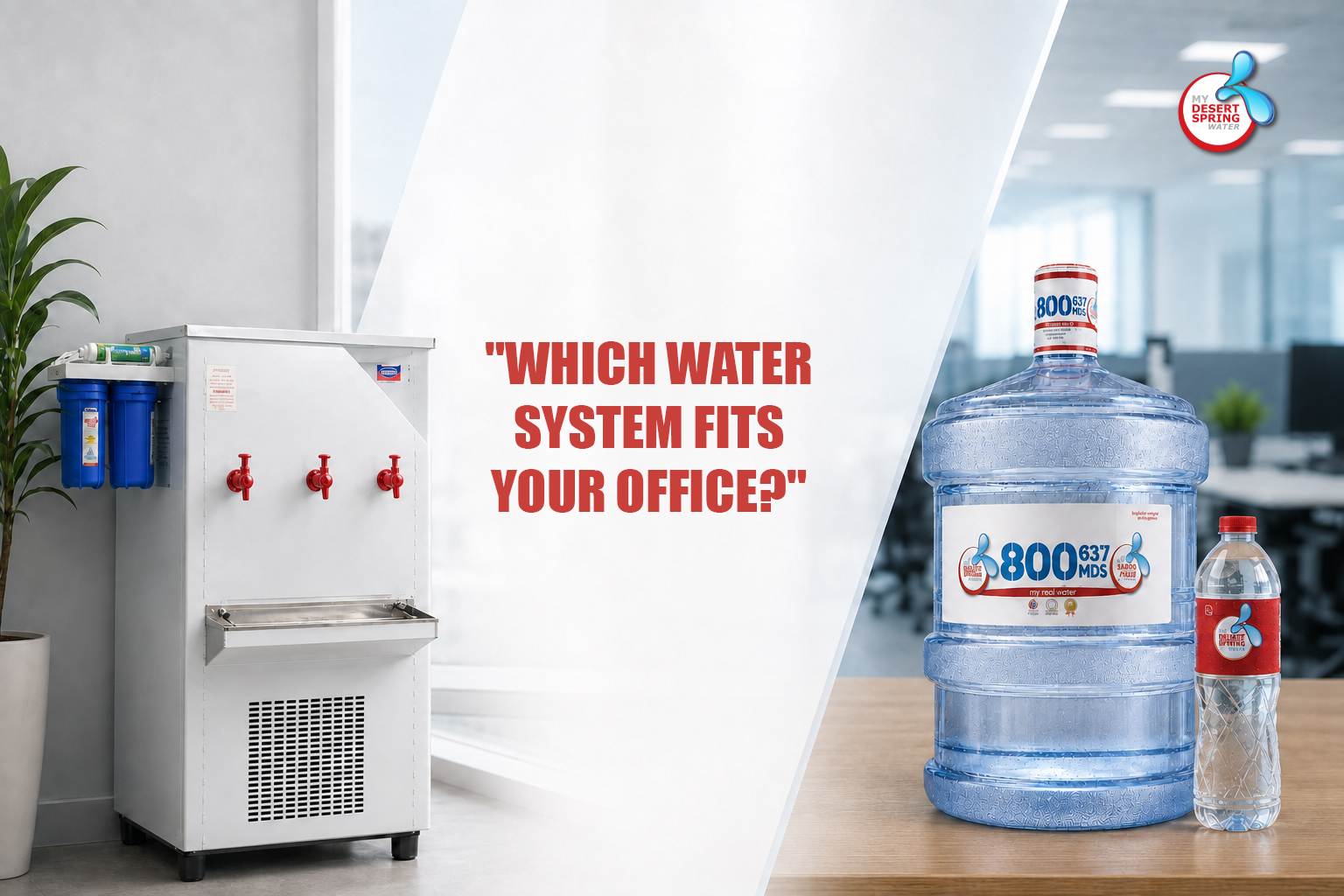
Choosing drinking water for an office sounds simple until somebody has to decide how the water will actually be supplied. For most UAE workplaces, the choice comes down to two systems: a 5-gallon bottle-fed water dispenser or a bottleless dispenser connected directly to the building’s water supply. Both can provide convenient drinking water, but they differ significantly in installation, maintenance, water traceability, flexibility and ongoing management.
For many small and medium-sized UAE offices, 5-gallon bottled water delivery offers a practical combination of flexibility, traceable product supply and simple setup. There is no need to connect the dispenser to the building’s plumbing, and bottles can be delivered according to actual office consumption.
A bottleless or plumbed-in dispenser can make sense for larger, permanent workplaces with high daily consumption and facilities teams capable of managing filter replacements, servicing and sanitation.
The right option ultimately depends on your office size, location, consumption and maintenance capabilities.
What Is the Difference Between Bottleless and 5-Gallon Water Dispensers?
Before comparing them, it helps to clear up the terminology.
A 5-gallon bottle-fed dispenser uses replaceable 5-gallon (approximately 18.9-litre) bottles supplied by a drinking water company. The dispenser does not need a connection to the building’s water line.
A bottleless water dispenser, sometimes called a plumbed-in or point-of-use dispenser, connects directly to the building’s water supply. Water passes through filters inside the system before being dispensed.
How Much Drinking Water Does an Office Need?
Office requirements vary according to the number of employees, working hours, season, outdoor activity and individual drinking habits.
As a planning estimate, businesses can calculate expected daily consumption first and then determine how many 5-gallon bottles or dispensing points they require.
For example, if an office consumes around 2 litres per employee per working day, an office with 25 employees could require approximately:
25 employees × 2 litres = 50 litres per working day
A 5-gallon bottle contains approximately 18.9 litres, meaning that level of consumption would equal roughly 2.6 bottles per working day.
Actual requirements can be higher or lower, particularly during the UAE’s hotter months.
This calculation gives businesses a much better starting point than simply ordering an arbitrary number of bottles and discovering the shortage when everyone is staring accusingly at an empty dispenser.
Which Option Is More Cost-Effective?
There isn’t one universal winner because the total cost depends on office size, consumption and how long the business plans to remain at the premises.
With a 5-Gallon Bottled Water System Businesses generally need to consider:
● cost of bottled water
● delivery frequency
● dispenser purchase or rental
● dispenser cleaning and sanitization
There is usually little or no plumbing work required, making the system relatively easy to install, expand or relocate.
With a Bottleless System Businesses should consider:
● Dispenser/equipment cost
● Plumbing and installation
● Filter replacement
● Periodic servicing
● Sanitization
● Potential repair or technician call-out costs
For a large office with consistently high consumption, a bottleless system may become financially attractive over time. For smaller offices or rented premises, however, the flexibility of bottled delivery can be more practical. Instead of comparing only the monthly water cost, businesses should compare the total cost of ownership over 12 to 24 months.
Which Option Provides Better Water Traceability?
With 5-gallon bottled drinking water, the product comes from an identified drinking water supplier. Product labels and supplier information can give businesses greater visibility into who produced the water and where the bottled product came from.
With a bottleless dispenser, the unit normally draws water from the building’s incoming water supply and filters it at the point of use.
The concern isn’t necessarily that the water has “no source.” Rather, office users may have less visibility at the dispenser into the incoming water’s journey, the condition of the internal filtration system, when filters were last replaced, and how consistently the equipment has been maintained.
This makes maintenance records particularly important for bottleless systems. For businesses where supplier traceability and consistency are priorities, bottled drinking water can offer a clearer supply chain.
Which Is More Hygienic?
Both systems can provide drinking water when they are properly handled and maintained. With a 5-gallon system, attention needs to be given to proper bottle storage, hygienic bottle handling and regular dispenser cleaning and sanitization.
With a bottleless system, hygiene depends heavily on the condition of the dispenser, internal components and filters. Filters must be replaced according to the manufacturer’s recommended schedule, and the system needs appropriate cleaning and servicing.
So the question isn’t simply: “Which system is hygienic?” A better question is: “Which system can your office maintain consistently?”
What About Taste and Consistency?
Taste can vary depending on the original water source, treatment process, filtration system and maintenance.
A bottled drinking water supplier provides a defined packaged product, which can help maintain consistency between deliveries.
With a bottleless system, the final drinking water can be influenced by the incoming building water, the type of filtration technology used, filter condition and maintenance.
For offices where employees and visitors expect a consistent drinking water experience, this is worth considering alongside cost.
Which Is Easier to Install and Manage?
A 5-gallon dispenser is comparatively straightforward. It generally requires an appropriate location and, for electric hot/cold models, access to a power socket.
Because there is no permanent water-line connection, businesses can relocate dispensers as teams move or offices are reorganized.
Bottleless dispensers require access to an appropriate water connection and installation. Once installed, they reduce the need for employees or delivery staff to replace bottles, but they introduce ongoing filter and equipment maintenance.
For leased offices, temporary locations and businesses expecting to move, the flexibility of a bottled system can be particularly useful.
What Happens If the System Stops Working?
Reliability should be considered before choosing either system. With multiple bottle-fed dispensers, a problem with one dispenser doesn’t necessarily affect every drinking water point in the workplace.
Bottled water can also be stored as backup stock. With a bottleless system, a dispenser fault, plumbing problem or overdue filter replacement may temporarily make that particular drinking station unavailable until the problem is resolved.
Large offices considering bottleless systems should therefore think about redundancy rather than relying on a single drinking water point.
Which Is More Sustainable?
The sustainability comparison is more nuanced than “bottle = waste, bottleless = green.”
Large 5-gallon bottles are designed for repeated use rather than functioning like ordinary single-use PET bottles.
They can go through repeated collection, inspection, cleaning, refilling and redistribution cycles when managed appropriately by the supplier.
Bottleless systems reduce the need to transport full water bottles, but they still require filters, replacement components, servicing and equipment.
For offices using 5-gallon water, a sensible approach is to use reusable 5-gallon bottles for everyday employee drinking water and reserve smaller PET bottles for meetings, visitors or situations where portability is genuinely needed.
Which System Should Your UAE Office Choose?
For small and medium-sized offices, 5-gallon bottled water delivery can be an attractive choice because it requires minimal installation, is easy to scale and provides a clearly identifiable bottled drinking water product.
For large, permanent offices with high consumption, a bottleless system may deserve consideration, particularly where the business already has a facilities team managing filtration, servicing and sanitation. For businesses with multiple locations across Dubai, Sharjah, Ajman and Umm Al Quwain, centralized bottled water delivery can also simplify drinking water management without installing and maintaining separate plumbed systems at every location.
The best choice isn’t determined by one arbitrary employee threshold. It depends on consumption, premises, installation limitations, maintenance resources and operational requirements.
Frequently Asked Questions
Is a bottleless water dispenser the same as a water cooler?
Not necessarily. “Water cooler” is a broad term and can refer to both bottle-fed and plumbed-in systems. A bottleless dispenser is specifically connected to the building’s water supply and usually filters the water before dispensing it.
Where does the water in a bottleless dispenser come from?
A bottleless dispenser generally receives water from the building’s incoming water supply. It then passes that water through the unit’s filtration system. Water quality at the point of use can therefore depend on the incoming supply, filtration technology, filter condition and maintenance.
Can I identify where 5-gallon bottled water comes from?
A reputable bottled drinking water product should carry supplier and product information that helps provide greater traceability. Businesses should check the bottle label and supplier documentation when selecting their drinking water provider.
Which system is better for a small UAE office?
A 5-gallon bottled system is often practical for smaller offices because there is little installation required, consumption can be adjusted as the team changes, and additional dispensers can be added when needed.
Which system requires more maintenance?
Both require maintenance, but of different kinds. Bottle-fed dispensers require regular cleaning and sanitization, while bottleless systems additionally depend on timely filter replacement and servicing of their internal filtration components.
There is no single drinking water system that suits every UAE workplace.
A bottleless dispenser can work well for permanent, high-consumption workplaces that have the infrastructure and resources to manage filtration and maintenance.
A 5-gallon bottled water system offers greater flexibility, minimal installation and clearer product traceability, making it particularly practical for small and medium-sized offices and businesses operating across multiple UAE locations.
For companies choosing a drinking water supplier in the UAE, the decision should go beyond price. Consider water traceability, delivery reliability, dispenser maintenance, workplace size and how easily the system can adapt as your business grows.