
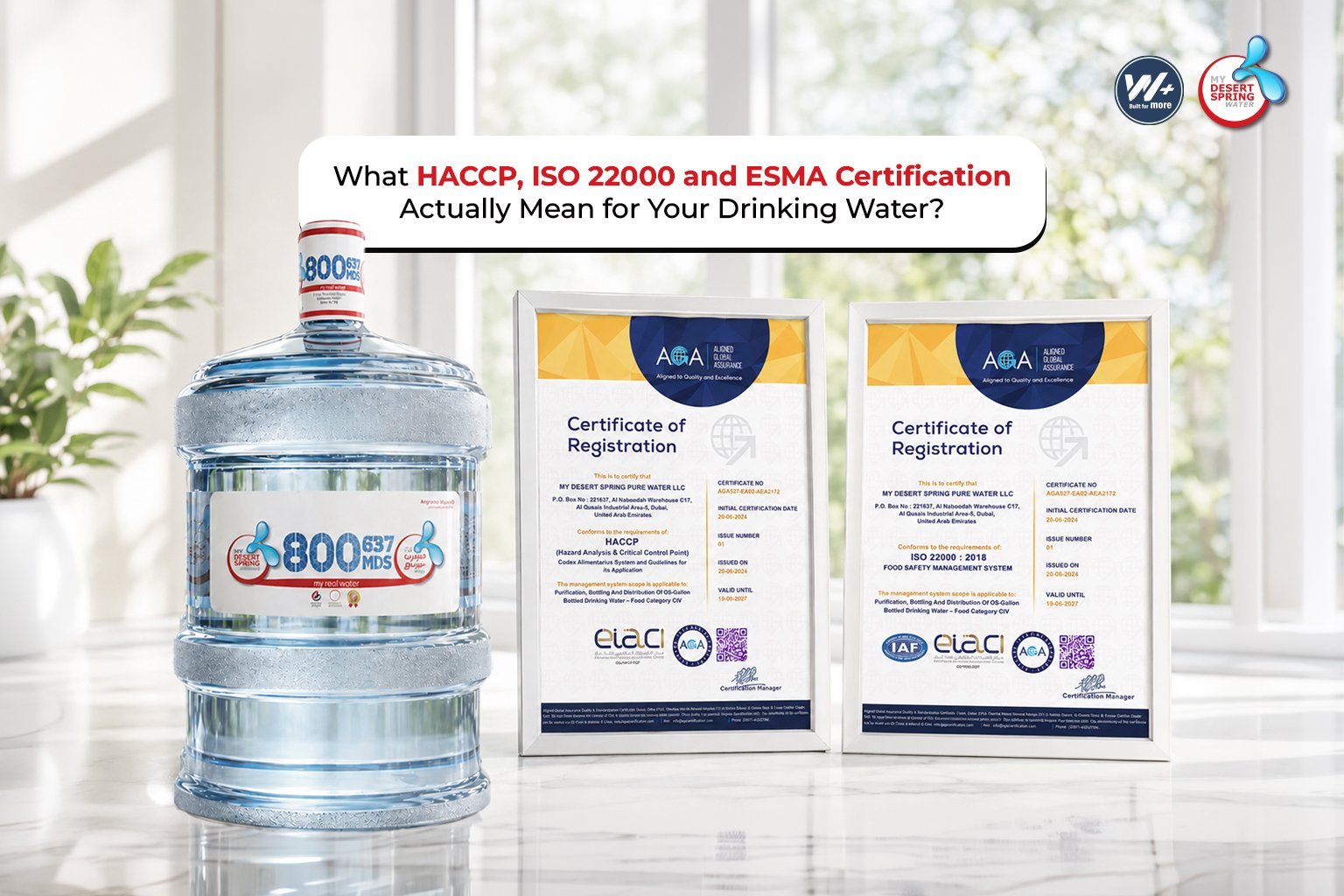
ESMA certified water in the UAE means the product carries the Emirates Quality Mark (EQM) — a certification that has been legally mandatory for every bottled water sold in the country since October 2014. HACCP is the hazard-control method used inside the plant. ISO 22000 is the full management system that governs that method. They are three different things, and most water companies show you all three logos without explaining any of them.
Here’s what each one actually covers, what none of them cover, and how to check in under two minutes whether the company delivering your 5-gallon bottles is genuinely certified or just displaying a logo.
HACCP vs ISO 22000 vs ESMA / EQM
Three certifications, three different jobs. They stack — they don’t replace each other.
| Certification | What it is | Who requires it | What it actually proves |
|---|---|---|---|
|
HACCP |
A hazard-control method — 7 principles, 12 steps, from the Codex Alimentarius |
Regulatory baseline for food and beverage operations |
The plant has identified where contamination could occur and put controls at those exact points |
|
ISO 22000 |
A full Food Safety Management System (FSMS) that contains HACCP inside it |
Voluntary — internationally recognised |
Food safety is run as a governed system: leadership accountability, documentation, internal audits, continual improvement |
|
ESMA / EQM |
The Emirates Quality Mark, the UAE’s national conformity mark
|
Mandatory for all bottled drinking water sold in the UAE |
The product and the factory were audited against UAE standards, and the water and packaging were independently lab-tested |
The simplest way to hold it in your head: HACCP is the engine. ISO 22000 is the vehicle built around that engine. EQM is the UAE government’s number plate confirming the whole thing is road-legal here.
ESMA Certification: What It Means in 2026 (and Why the Name Is Outdated)
ESMA certification for drinking water is now issued by MoIAT — the Ministry of Industry and Advanced Technology. The Emirates Authority for Standardization and Metrology (ESMA) was merged into MoIAT in July 2020, and all of its powers, schemes and responsibilities transferred with it.
The industry still says “ESMA certified” out of habit. Almost every water company website in the UAE still uses the old name. It isn’t wrong in spirit — the scheme and the standards are unchanged — but if you want to verify a supplier today, you are looking for a MoIAT-issued Emirates Quality Mark, not an ESMA certificate.
The facts worth knowing:
- Mandatory since October 2014, under UAE Cabinet Resolution 26 of 2013. Bottled water sold without EQM can be pulled from the market.
- Applicable standards: UAE.S / GSO 1025 for bottled drinking water, and UAE.S / GSO 987 for natural mineral water.
- Valid for 3 years, then re-certification is required — this is the detail most consumers never check.
- Penalties for non-compliance have been reported in the range of AED 30,000 to AED 100,000, plus product removal from the market.
The part almost nobody tells you
Because EQM is mandatory, “ESMA certified” is not a mark of excellence — it is the legal minimum. Every legitimate bottled water brand in the UAE has it. If a company’s entire quality story is “we’re ESMA certified,” they’ve told you they are allowed to operate. Nothing more.
The genuine differentiators sit elsewhere: whether the certificate is current, whether the company also holds ISO 22000, and whether they’ll show you the paperwork when you ask.
What HACCP Actually Covers
HACCP is a preventive method, not a paperwork exercise. It identifies where contamination could realistically enter the process, sets a Critical Control Point at each of those places, and defines the limit and the corrective action if that limit is breached.
It runs on seven principles applied through 12 implementation steps:
- Hazard analysis — biological, chemical and physical risks mapped across the process
- Determine Critical Control Points (CCPs) — the specific stages where control is essential
- Set critical limits for each CCP — measurable thresholds, not opinions
- Establish monitoring — how each CCP is checked, how often, by whom
- Define corrective actions — exactly what happens when a limit is missed
- Verification — proof the system is working, not just being documented
- Record-keeping — the audit trail that makes all of the above provable
For a 5-gallon water operation, CCPs typically cover source water treatment, filtration and disinfection stages, bottle washing and sanitisation, and the filling and capping environment.
What HACCP does not cover: management accountability, staff competence requirements, internal audit programmes, or continual improvement. It controls hazards. It doesn’t govern the business around them. That’s the gap ISO 22000 fills.
What ISO 22000 Adds on Top of HACCP
ISO 22000 is a complete Food Safety Management System that includes every HACCP principle and then wraps a governance structure around it. A company certified to ISO 22000 is, by definition, already running HACCP — the reverse is not true.
What it adds that HACCP alone does not require:
- Top management accountability — food safety is a leadership responsibility with defined ownership, not something delegated to the plant floor
- A documented FSMS covering policy, objectives, competence and communication
- Internal audits and management reviews on a fixed cycle
- Prerequisite Programmes (PRPs) and OPRPs as specific, categorised requirements — reducing the common HACCP failure of labelling everything a CCP
- Continual improvement built into the standard
- Structural alignment with ISO 9001, so quality and food safety run on one system rather than two
Why this matters when you’re choosing a water supplier: ISO 22000 is voluntary. Most 5-gallon delivery operations in the UAE hold EQM because they legally must, and HACCP because it’s expected. Far fewer take on ISO 22000 certification, because it means external auditors examining how the company is run, not only how the water is treated.
What Certification Does Not Guarantee
This is the section most water company blogs leave out, so read it before you take any brand’s logo strip at face value.
- Certification is a snapshot with an expiry date. EQM runs on a three-year cycle. A logo on a website tells you nothing about whether the certificate is still valid this month.
- It doesn’t cover what happens after the bottle leaves the plant. Storage temperature in the delivery vehicle, how long a bottle sits in direct sun, and whether the delivery team handles the cap hygienically are operational discipline — not certification scope.
- It doesn’t stop a bottle being overused. Polycarbonate 5-gallon bottles have a finite number of safe refill cycles. Bottle rotation discipline is on the supplier, and it’s a fair question to ask directly.
- A logo is not a certificate. Anyone can put an EQM image on a website footer. The certificate number, issuing body and expiry date are what count.
Ask any supplier — including us — these four questions: What is your EQM certificate number? When does it expire? Do you hold ISO 22000 in addition to HACCP? How many refill cycles do your 5-gallon bottles go through before retirement?
A certified supplier will answer all four without hesitating.
Why the Bottle Matters as Much as the Water in the UAE Summer
EQM certification tests the packaging, not just the water inside it. As part of the assessment, bottled water containers undergo microbiological and migration testing — including at temperatures up to 60°C — carried out by a third-party laboratory accredited to ISO 17025.
That 60°C figure is the one to remember, because it’s the direct answer to the question people in Dubai, Sharjah, Ajman and Umm Al Quwain actually worry about: what happens to a plastic bottle sitting in the heat? The migration test exists precisely to establish that certified packaging remains safe at the temperatures a UAE supply chain realistically hits.
It also explains why where the bottle sits between the plant and your kitchen is a legitimate thing to ask about — an area no certificate covers on the supplier’s behalf.
My Desert Spring Water: Our Certifications and Service Area
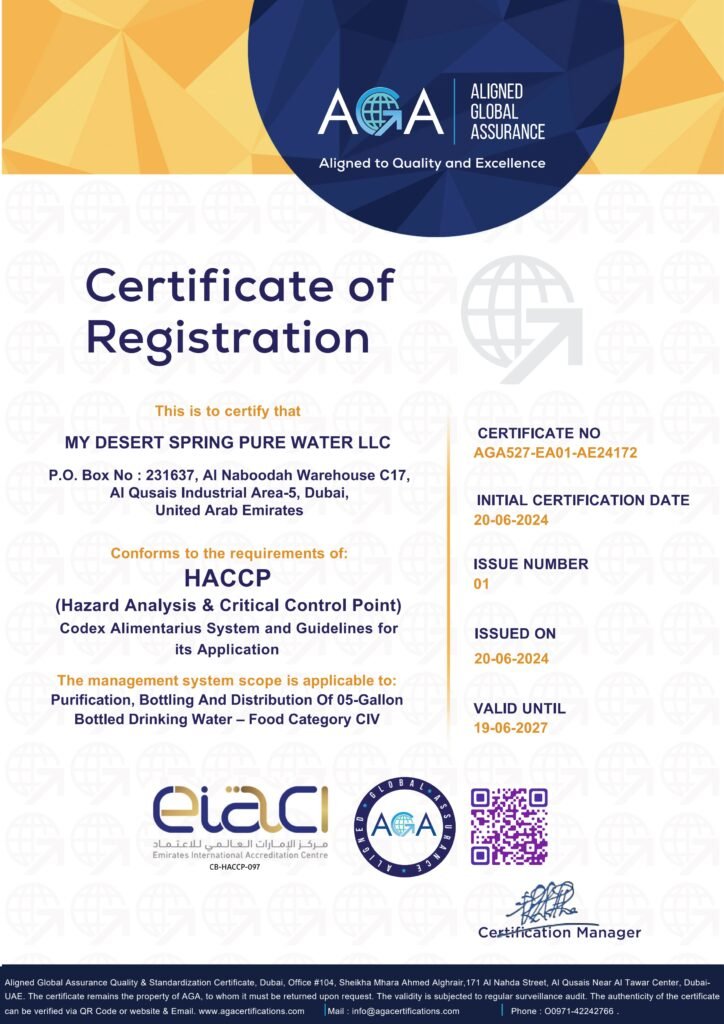
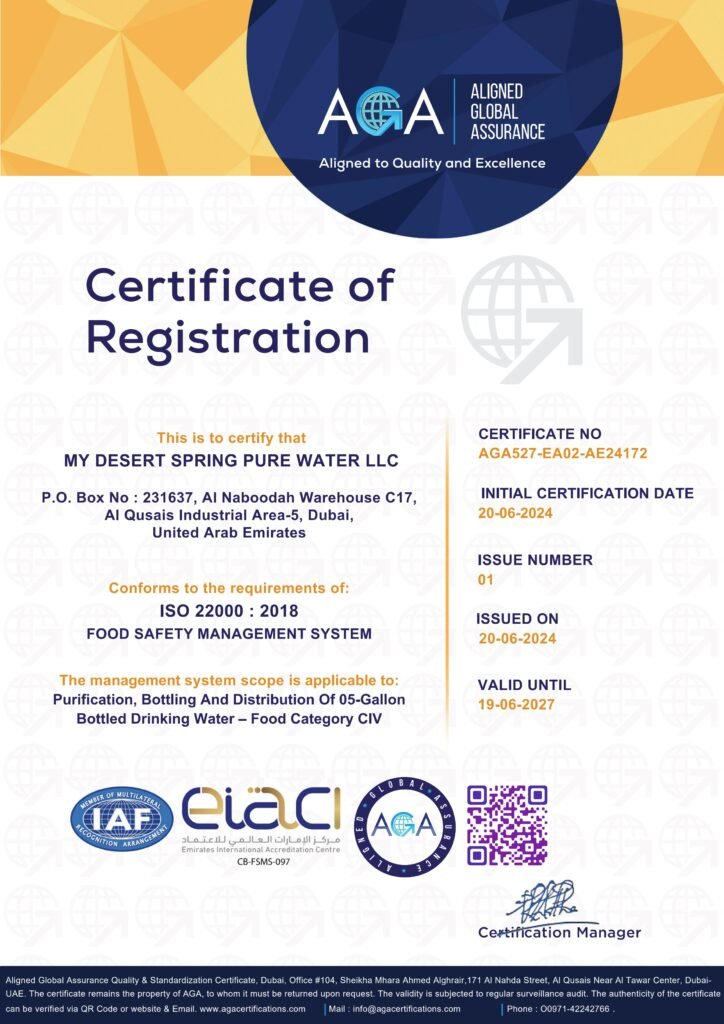
My Desert Spring Water holds HACCP, ISO and ESMA (EQM) certification and has been delivering 5-gallon bottled water in the UAE for over 25 years.
Where we deliver:
- Dubai — homes, apartments, villas, offices and corporate sites
- Sharjah — residential and commercial delivery
- Ajman — residential and commercial delivery
- Umm Al Quwain — residential and commercial delivery
We also supply water dispensers, PET bottles, storage racks and pumps, so a household or office can be set up in a single order.
Get Certified Water Delivered — and Verify It Before You Order
Don’t take a logo strip at face value from anyone, including us. Ask for the certificate.
WhatsApp us and ask for our certification details before you place your first order. We’ll send them across, along with delivery scheduling for your area in Dubai, Sharjah, Ajman or Umm Al Quwain.
Ready to switch? Message us on WhatsApp with your area and how many bottles you use per week, and we’ll confirm a delivery schedule the same working day.
Frequently Asked Questions
Is ESMA certification mandatory for bottled water in the UAE?
Yes. The Emirates Quality Mark (EQM) has been mandatory for all bottled water sold in the UAE since October 2014, under Cabinet Resolution 26 of 2013. Because it’s a legal requirement, it confirms a brand is compliant — not that it’s higher quality than another.
Who issues ESMA certification now?
MoIAT — the Ministry of Industry and Advanced Technology. ESMA merged into it in July 2020 and now runs the Emirates Quality Mark scheme. The term “ESMA certified” is still widely used, but the current authority is MoIAT.
What is the difference between HACCP and ISO 22000?
HACCP is a hazard-control method with seven principles. ISO 22000 is a full Food Safety Management System that contains HACCP and adds leadership, audits and continual improvement. Any ISO 22000-certified company already applies HACCP — the reverse isn’t true.
How do I check if a water supplier is really certified?
Ask for their EQM certificate number, issuing body and expiry date — it runs on a three-year cycle. A logo isn’t proof; certificates expire while images stay online. Also ask if they hold ISO 22000, not just HACCP.
Does the certification cover the plastic bottle or only the water?
Both. EQM assessment includes migration testing of the packaging at up to 60°C by an ISO 17025-accredited lab. What it doesn’t cover is handling after the plant — delivery temperature, sun exposure, and bottle refill cycles.